23-07-14

VCAP-DTA Objective 6.3 – Analyze PCoIP Metrics for Performance Optimization

Skills and abilities being tested :-

  • Interpret PCoIP WMI counters – When you install the View Agent on a virtual desktop, additional WMI (Windows Management Interface) counters are added to the Windows virtual desktop. Amongst other things, it allows you to add in statistics for PCoIP performance which can come in very handy when troubleshooting performance issues. To do this, go to the virtual desktop and go Start | Run | perfmon.exe and once Performance Monitor starts, click on the green plus button and add in your required counters. You can choose from the following areas:-
    • PCoIP Session Audio Statistics
    • PCoIP Session General Statistics
    • PCoIP Session Imaging Statistics
    • PCoIP Session Network Statistics
    • PCoIP Session USB Statistics

   The key point here is not to add all the counters and get blinded by lines shooting around all over the place, and remember that the PCoIP server needs to be active in order to generate statistics. That means if you       connect to a virtual desktop via RDP, you will see counters all flatlined and wonder what all the fuss is about! The View Integration Guide has some really good guidance on how to interpret the metrics here and worth a read to help make sense of the perfmon statistics. This is worth a read to get the equations on how to calculate bandwidth used for audio and video etc. If you are having performance issues, it may be that you have set an aggressive group policy that throttles bandwidth too low and the connection is maxing out it’s assigned bandwidth. Remember you do have the View PDFs to hand in the exam, so you can open the Integration guide and go straight to this section to save you from having to remember how to compute bandwidth values.

  • Interpret PCoIP log files – PCoIP log files are stored under %PROGRAMDATA%\VMware\VDM\logs and Simon Long has an excellent blog post on how to interpret PCoIP log files, so take a look at that before the exam. It mainly discusses the PCoIP Log Viewer, which to the best of my knowledge you won’t have access to in the exam but all of the relevant metrics to look out for are there in the text. The Log Viewer just puts it in a more friendly format. That being said, if you have a look at Andre Leibovici’s guide, for the sake of the exam it’s worth remembering key words or phrases and then searching the log files for those key words. Remember, time in the exam is a luxury you don’t have! Look out for the following:-
    • Registry setting parameter pcoip.max_link_rate 
    • Loss= (signifies packet loss on the network)
    • Plateau (maximum bandwidth used by PCoIP)

    Andre has another article on key word searches in log files here, well worth a read.

22-07-14

VCAP-DTA Objective 6.2 – Configure Group Policies for PCoIP and RDP

  • Identify and resolve group policy conflicts – One of the great things about group policies is that there are so many settings you can configure and lock down that sooner or later you’ll end up doing something that means different group policies treading on each other’s toes. There are a couple of ways to check group policy inheritance:-
    • gpresult.exe – a command line tool that can be used to generate a RSoP report (Resultant Set of Policies). This is a quick way of looking at what’s been applied, what has been filtered and which AD groups a user is a member of, which can help troubleshooting. The command syntax for a RSoP style report is gpresult.exe /r and you’ll get something similar to below:-

Microsoft (R) Windows (R) Operating System Group Policy Result tool v2.0
Copyright (C) Microsoft Corp. 1981-2001

Created On 22/07/2014 at 20:34:43
RSOP data for BECKETT\Administrator on DC01 : Logging Mode
———————————————————–

OS Configuration: Primary Domain Controller
OS Version: 6.1.7600
Site Name: Default-First-Site-Name
Roaming Profile: N/A
Local Profile: C:\Users\Administrator
Connected over a slow link?: No
COMPUTER SETTINGS
——————
CN=DC01,OU=Domain Controllers,DC=beckett,DC=local
Last time Group Policy was applied: 22/07/2014 at 20:34:10
Group Policy was applied from: DC01.beckett.local
Group Policy slow link threshold: 500 kbps
Domain Name: BECKETT
Domain Type: Windows 2000

Applied Group Policy Objects
—————————–
Default Domain Controllers Policy
Default Domain Policy
ThinPrint

The following GPOs were not applied because they were filtered out
——————————————————————-
Local Group Policy
Filtering: Not Applied (Empty)

The computer is a part of the following security groups
——————————————————-
BUILTIN\Administrators
Everyone
BUILTIN\Pre-Windows 2000 Compatible Access
BUILTIN\Users
Windows Authorization Access Group
NT AUTHORITY\NETWORK
NT AUTHORITY\Authenticated Users
This Organization
DC01$
Domain Controllers
NT AUTHORITY\ENTERPRISE DOMAIN CONTROLLERS
Denied RODC Password Replication Group
System Mandatory Level

USER SETTINGS
————–
CN=Administrator,CN=Users,DC=beckett,DC=local
Last time Group Policy was applied: 22/07/2014 at 20:33:40
Group Policy was applied from: DC01.beckett.local
Group Policy slow link threshold: 500 kbps
Domain Name: BECKETT
Domain Type: Windows 2000

Applied Group Policy Objects
—————————–
N/A

The following GPOs were not applied because they were filtered out
——————————————————————-
Default Domain Policy
Filtering: Not Applied (Empty)

ThinPrint
Filtering: Not Applied (Empty)

Local Group Policy
Filtering: Not Applied (Empty)

The user is a part of the following security groups
—————————————————
Domain Users
Everyone
BUILTIN\Administrators
BUILTIN\Users
BUILTIN\Pre-Windows 2000 Compatible Access
NT AUTHORITY\INTERACTIVE
CONSOLE LOGON
NT AUTHORITY\Authenticated Users
This Organization
LOCAL
Group Policy Creator Owners
Domain Admins
Schema Admins
Enterprise Admins
Denied RODC Password Replication Group
High Mandatory Level

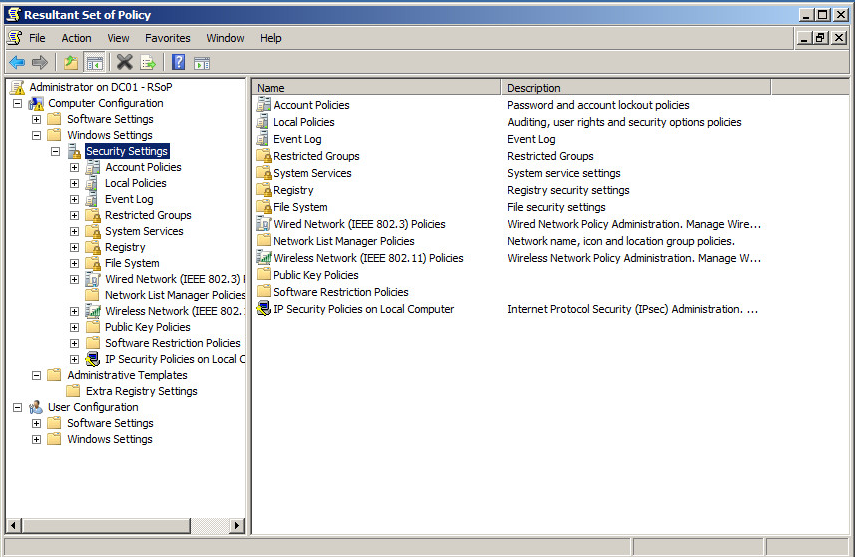
  • RSoP (Resultant Set of Policies) is basically a graphical representation of what you see above, which is actually quite helpful when you have a specific issue you want to troubleshoot. To run the report, go to Start | Run | rsop.msc and after the report has been generated, you kind of get a read only group policy view with details of policy settings.

rsop


  • Group Policy Management – One other thing to check is the Group Policy Management MMC tool. This can be accessed by going to Administrative Tools | Group Policy Management. Once within this tool, select a particular OU that you want to troubleshoot and click the Group Policy Inheritence tab. This displays which GPOs are in place and what their priorities are.

gpo


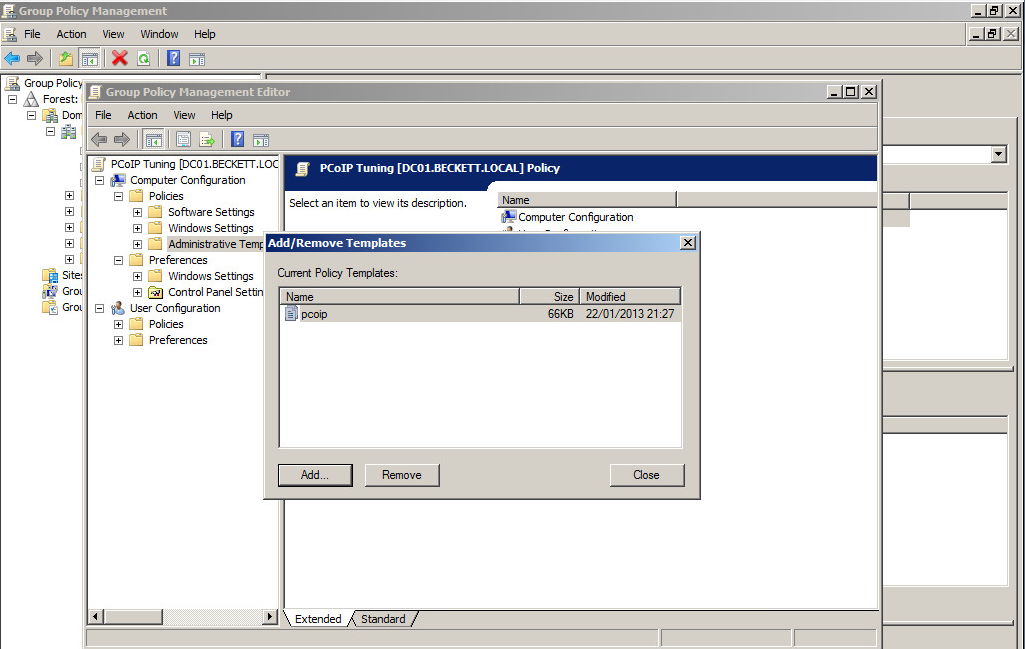
  • Implement PCoIP and RDP Group Policy templates – As discussed in a previous article, PCoIP can be managed by importing the pcoip.adm policy template from the C:\Program Files\VMware\VMware View\Server\extras\GroupPolicyFiles folder into the Group Policy Management  MMC view.
    • RDP can be managed via Group Policy from Group Policy Management under  Computer Configuration\Policies\Administrative Templates\Windows Components\Remote Desktop Services. From here, configure which settings you want to enable or disable etc, as shown below:-

RDP-GPO


21-07-14

VCAP-DTA Section 6 – Configure and Optimize View Display Protocols

Section 5 and dealing with ThinApp is now behind us, and now we turn to the networking stack. As you may know if you’ve done a bit of light reading, PCoIP is the protocol of choice for connecting to virtual desktops hosted by View. It’s a protocol proprietary to Teradici, so it’s not strictly an “in house” technology to VMware, but it has been in View for many years (since View 4, I think), so it’s a very mature and robust protocol.

One of the cool things about PCoIP is that it can do a level of auto tuning when there is congestion on the network. The VCAP-DTA blueprint has three sections for troubleshooting and configuration of PCoIP with just a couple of skills and abilities being measured per objective.

Objective 6.1 – Configure PCoIP and RDP for Varying Network Conditions

  • Determine appropriate configuration parameters based on network performance – It’s typical that on a slow link you will want to tune PCoIP to be a little less aggressive with the bandwidth it uses. This can be done by using the PCoIP group policy template pcoip.adm which comes with the Connection Server in C:\Program Files\VMware\VMware View\Server\extras\GroupPolicyFiles folder. Import this template into your Group Policy Management MMC view and you are then able to configure PCoIP settings.
  • Configure QoS and CoS settings for PCoIP

pcoipadm

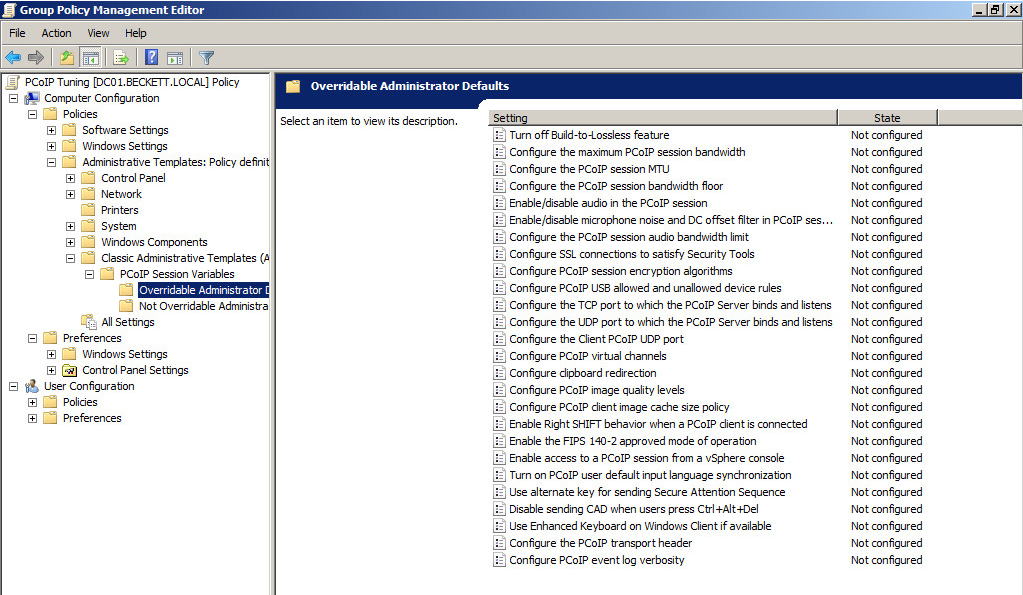
Once imported, go to Computer Configuration | Administrative Templates | Classic Administrative Templates | PCoIP Session Variables to configure PCoIP settings.

pcoipvariables

Typically, you will need to alter the following values to reduce bandwidth on a slow link :-

      • Turn off Build-To-Lossless feature – Enabled
      • Configure the maximum PCoIP session bandwidth – 10% less than WAN link speed 
      • Configure PCoIP image quality levels –
        • Minimum Image Quality default is 50 and can be from 30-100, reduce this value to reduce bandwidth at the expense of user graphics experience
        • Maximum Initial Image Quality default is 90 and can be from 30-100. Reduce this value to reduce the initial screen “burst” as it is drawn.
        • Maxium Frame Rate  default is 30, this can be between 1-120 but if you reduce the value you reduce bandwidth but increase video jitter.
        • PCoIP session bandwidth floor by default is 0 (unset) but this value tells PCoIP the least amount of bandwidth it can expect for an end user and reserves this amount of bandwidth
        • Client image cache size policy is useful when the View Client end has some local storage it can cache to. For example, thin clients and regular PCs (tablets too, I guess) can cache regularly used images to help improve performance. This setting is probably useless on a zero client because it has no local storage, so watch out you don’t get a curveball there on the exam!

04-07-14

VCAP-DTA – Objective 5.3 – Compile and Deliver Full or Streaming Applications

So now the prep work has been done to get Active Directory ready for ThinApps, the next thing to do is to actually roll some! The recommendation is to have a clean vanilla install of the platform you want to virtualise on (so a clean Windows 7 machine for an app to be deployed to Windows 7). I’ve heard people say to virtualise on XP and then you can have an app on the lowest common denominator, but for the exam that’s a level of detail we’re not concerned with.

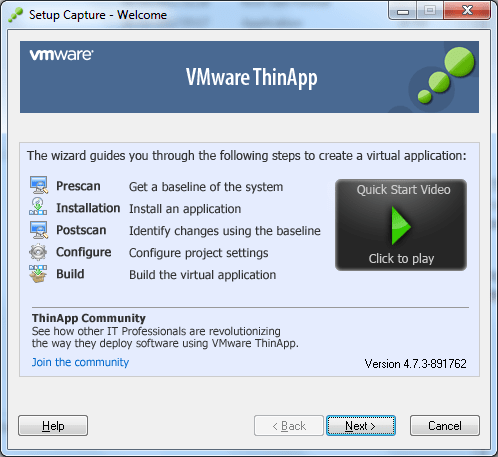
  • Build and modify a ThinApp project – The first task is to roll an application using the ThinApp packager by running the Setup Capture wizard either remotely or from a locally installed copy. This is a five step process which basically involves Prescan, Installation, Postscan, Configure and Build. It’s all wizard driven as per below :-
setup-capture

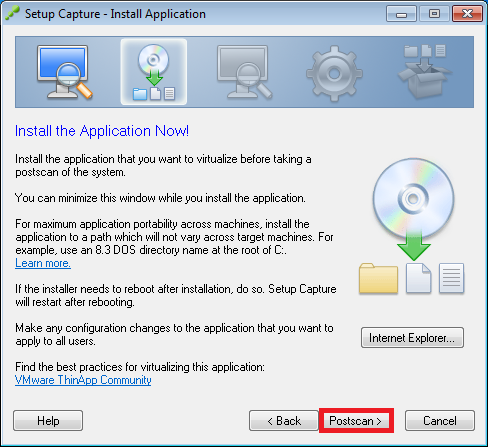
In the interests of time in the exam, I’m guessing you’ll be asked to package something reasonably cheesy and small, such as 7-Zip. Run the pre-scan task to get a “before” configuration snapshot. This doesn’t usually take longer than a couple of minutes. Once it’s done, you’ll be asked to run the installer, do this now. Always worth making sure you run the installer as an Administrator, that can sometimes cause odd things to happen to applications (and may well turn up in the exam). Once the install has completed, hit the postscan button to perform the “after” snapshot of the local filesystem and registry. You may get a warning to ensure the application has completely installed, so just double check this before you continue.

install


Once the post scan is complete, you’ll be asked to choose an entry point. This is basically the application executable. The wizard is usually pretty good at getting this right, but double check anyway. If you install a suite of products (say Office), you’ll need to add an entry point for each application such as Word, Excel, etc.

The next step chooses whether or not to manage the application via Horizon or if you’re updating an existing package. Choose as appropriate. The next step is to select which AD groups (if any) have access to the application. My guess is in the exam, you’ll be asked to restrict this app to a particular group and then test it.
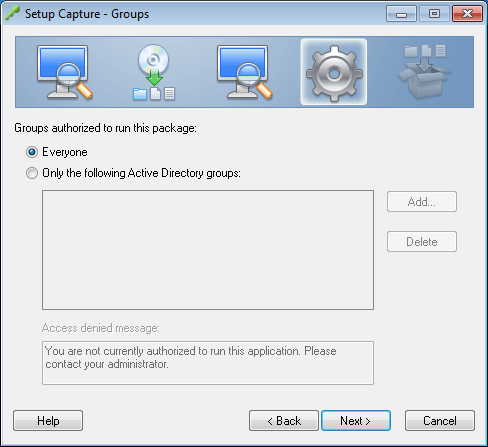
groups

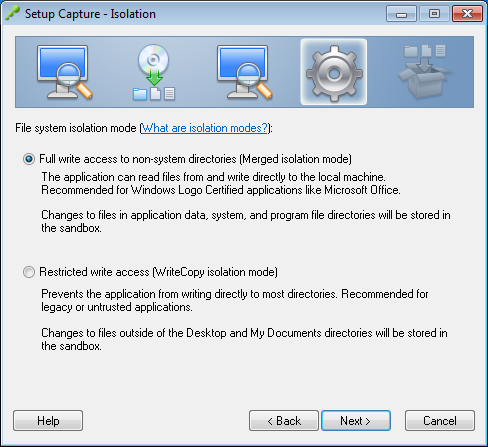
Next step is the application isolation mode. This is the kind of thing vendors love to test on exams. The default is merged isolation mode and allows the application access to read and write outside of the ThinApp sandbox. If I could dream up a test scenario for this, it would be that a virtualised app is playing up because it’s in WriteCopy isolation mode. This mode intercepts writes and stores them in the sandbox.  The use case for this is a highly locked down environment where you don’t want users writing to the local filesystem into system folders etc. The dialog is shown below:-

isolation-mode


The next choice is the sandbox location. This is typically left as the default of the user’s profile. This basically allows the user to roam and still have access to the application sandbox. There may be cases where a USB stick is appropriate, and it may be there is a scenario on the exam where you need to alter this from USB to Profile to fix a fault.
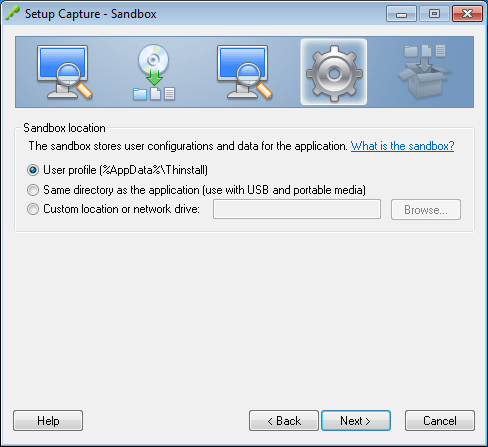
sandbox

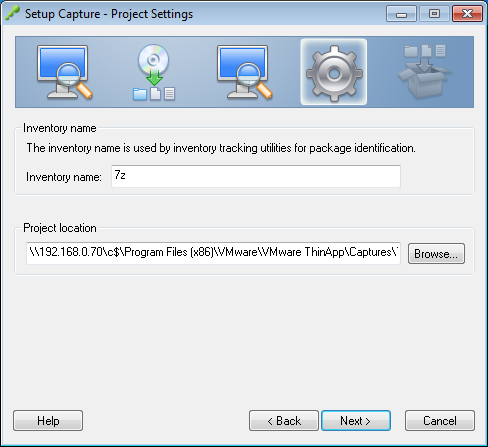
Click Next and you’ll be asked if you want to send feedback to VMware. I highly doubt your exam score will have any bearing on what you choose here, but just in case it’s specified in the scenario… Then give the application an inventory name (AKA folder name in the Captures directory) and a path to store project files. If you’re running the Setup Capture from a network share, chances are this will be pre-filled for you, as below:-

project

Select the primary data container (which is the application you wish to run) and whether or not you want to build the ThinApp as an MSI and whether or not to add compression, as per below. Click Save when you’re done:-

pdc

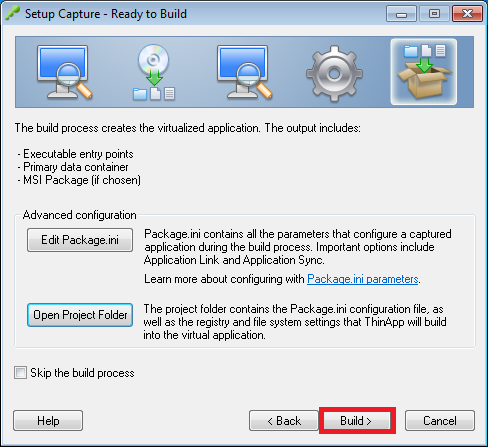
You’re now at the final step before the build process kicks off. You still have the opportunity at this stage to edit the package.ini file with any last minute adjustments you need before you start. There is still time at this stage too to go back in the wizard if you forgot to check the MSI build option in the previous screen. If all is well at this point, hit the Build button as shown below:-

build


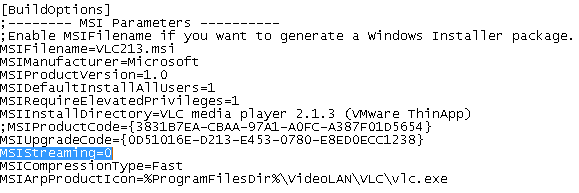
  • Configure MSI Streaming – This is a pretty easy task. Once you have a built ThinApp, open the package.ini file in the directory and open with Notepad or some other text editor. Find the section entitled [BuildOptions] (hint – it should be near the top!) and find the line that says MSIStreaming=0. Change this to MSIStreaming=1 and most important of all, don’t forget to rebuild the ThinApp with the new setting! To do this, run the build.bat file in the ThinApp package directory (i.e. the one with your ThinApped application files in). When the rebuild completes, copy the bin folder contents over to your ThinApp repo you previously defined.

msistreaming


You will also then need to add the application into the ThinApp dialog in View Administrator. Go to Inventory | ThinApps | Scan New ThinApps.. | Select the ThinApp repo | Select the folder to scan for new ThinApp(s) | Next | Select any detected applications you want to add | Click Scan | Click Finish.

  • Deploy ThinApp applications to desktop pools – Once you have one or more ThinApps created and then added to View Administrator, you need to configure usage. In the case of desktop pools, this is easy to do. From View Administrator, choose Inventory | ThinApps | Pick your ThinApp from the list | click on the Add Assignment spin button | select Assign Pools | select the required pool(s) in the dialog and click Add | if the ThinApp has been set for streaming, choose the Installation Type radio button for either Streaming or Full.
  • Configure ThinApp entitlement using View Administrator – To be honest, I don’t understand this objective. You can assign ThinApps by pool or by specific desktop, and that is the limit of what View Administrator can do. It may be that this objective is dealing with desktop specific assignment, if so, simply repeat the steps above but choose individual desktops instead of pools.

 

02-06-14

VMUG North West England meeting – 18th June


Logo


That time is upon us again and the next NW England VMUG meeting will be taking place as usual in the Crowne Plaza Hotel in Manchester on Wednesday 18th June. The agenda at time of writing is listed below :-

Morning Design Workshop – Darren Woollard, Xtravirt
Lunch
PernixData Presentation: Re-Think Storage Performance – James Smith
Community Presentation: Home Lab Storage and Lessons Learnt – James Kilby
Calyx MS Presentation: Hybrid Cloud and Calyx Silver Lining
Community Presentation: VMware Certification – Chris Beckett
vNews – Ashley Davies
Raffle and vBeers at Tiger Tiger Printworks

You may notice yours truly at the bottom of the agenda. It will be my VMUG debut as a presenter and my session will basically cover the VMware certification tracks, mainly focussing on the VCAP exam formats. My hope is that I can demystify it a little bit and offer some words of guidance on the best way to prepare for them as I’ve passed three of them now.

To register, please visit the VMUG group page. Looking forward to seeing you there!


02-04-14

VCAP-DTA – Objective 5.2 – Deploy ThinApp Applications using Active Directory

Once we have a repository configured for our ThinApps, we next continue the groundwork by preparing Active Directory. We can then harness Active Directory groups to control access to the ThinApps.

  • Create an Active Directory OU for ThinApp packages or groups – From your domain server, go to Administrative Tools and select Active Directory Users and Groups. From wherever in the hierarchy the exam asks you to, right click and select New, Organizational Unit. Give the OU a name and click OK.
  • Add users to individual ThinApp package OU or groups – Again not really a View skill as such, just some basic AD administration. Now you created your OU(s) as above, to create a user right click on the ThinApp OU, click New, User, fill out the appropriate details, click Next, enter password information and click Next and Finish. To add a group, right click on the appropriate OU, click New, Group, give the group a name and select the type and click OK. To add users to an existing group, double click the group, click Members, Add and enter the user names and click Check Names. Click OK twice.
  • Leverage AD GPOs for individual ThinApp MSIs – Group Policy can be used to publish an existing ThinApp MSI without the need for a repository, or in parallel. To configure this, go to Administrative Tools, Group Policy Management. Right click the OU in which you would like to create the GPO. Select Create a GPO in this domain, and link it here (for a new GPO, or select Link an existing GPO if asked).Name the GPO and click OK. Once the GPO is created, right click on it and select Edit. In either Computer Configuration or User Configuration select Policies and then Software Settings. Right click on Software Installation and select New, Package. Browse to the network location of the MSI and select the MSI and then Open. Accept the defaults to Assign the package to a user or computer or click Advanced for further settings. Click OK. If you select Advanced, use the tabs across the top to make changes as appropriate and click OK. You may need to run gpupdate.exe to refresh Group Policy.
  • Create and maintain a ThinApp login script – The ThinReg utility can be used in an existing login script to deploy ThinApps to users. For example, in the NETLOGON share, you can add a line or lines into the logon script to invoke thinreg.exe. In it’s simplest form, just add the line thinreg.exe \\server\share\application.exe /Q. The /Q switch just runs the command silently. It may well crop up as a specific requirement on the exam.

01-04-14

VCAP-DTA – Objective 5.1 – Create a ThinApp Repository

There are two objectives in this section which are around setting up the ThinApp repository on the network to be used by the View infrastructure to distribute applications from. It’s telling that this topic has several tools references to it, so we’re going outside the confines of the View Administration guide really for the first time.

Again it’s difficult to imagine within the confines of a tight three hour exam that you will be asked to package up anything other than a relatively simple application, but be prepared for the odd curve ball. Ultimately as long as you understand the fundamentals, you can go a long way to scoring points on this objective, even if you don’t get it completely right.

  • Create and configure a ThinApp repository – The creation of the ThinApp repository is done from within View Administrator. Go to View Configuration, ThinApp Configuration, Add Repository then enter in a Display Name and Share Path (e.g. \\server\thinapp\repo) and add a Description if you like.
     
  • Configure a ThinApp repository for fault tolerance using DFS or similar tools – In order to create a DFS share, you need to have the File Services role enabled on the server. DFS is basically a network share made up of chunks of storage from different servers. You reach the DFS share by using the path \\domain\\dfsroot, so for example \\beckett.local\dfs-share. DFS also has file replication technology built in you can use for further resilience. I can’t really think you’ll be asked to do too much with DFS in the exam as much of this is based on the Windows server itself. What you will probably need to know is how to point a ThinApp repository at a DFS share (so use the example syntax above). This is pretty much all that is listed in the ThinApp reference materials.

06-03-14

VCAP-DTA – Objective 3.2 – Configure and Manage Pool Tags and Policies

This objective is relatively short and only has one skill being measured, the ability to correctly configure tags. As a refresher, tags can be used to provide a level of security on connection servers and pools and gives the ability to provide what VMware refers to as “Restricted Entitlement”, which means Connection Servers can only access certain pools. The most obvious and common use case for tagging is when Security Servers are in play, and you want to restrict incoming users from the internet to only use particular Connection Servers.

So then, with only one skill/ability being measured in this section, let’s get to it!

  • Configure tagging for specific Connection Server or security server access – Tagging is done from within View Administrator. You can set tags on Connection Servers and also on pools. One thing you need to be aware of is tag matching – this defines whether or not a user is permitted access to a desktop and will most likely be something you’ll be tested on in the exam.
    • To set a tag on a Connection Server, go to View Administrator and View Configuration, Servers, Connection Servers, choose your Connection Server, click Edit and in the top box, assign the tags you want to use. The example below illustrates two tags in use. This is an internal Connection Server, so it’s been tagged as “Internal” and “Secure”. Note a comma separating multiple tags.

tags

    • To add tags to an existing pool, in View Administrator go to Inventory, Pools, select the Pool you wish to tag, click Edit and then Pool Settings. At the top of this screen is General and Connection Server Restrictions. Click Browse and click the Restricted to these tags radio button. Select the appropriate tag as per below :-

pool-tags

    • Click OK to apply the setting.
    • To apply a tag during pool creation, when you get to the Pool Settings screen, you basically access the same dialog screen. So under the General heading at the top, go to Connection Server Restrictions, click Browse and select the appropriate tag as shown above.
  • In respect of tag matching, be aware of the following matrix as you may be asked to troubleshoot an access issue during the exam which may be caused by incorrect tagging :-
    • Connection Server no tags – Pool no tags – access permitted
    • Connection Server no tags – Pool tags  – one or more tags – access denied
    • Connection Server one or more tags – Pool no tags – access permitted
    • Connection Server one or more tags – Pool one or more tags – access depends on tags matching

VCAP-DTA – Objective 3.3 – Administer View Desktop Pools

This objective is the guts of spinning up virtual desktops for users, and covers the full range of desktop pool types available. So full and linked clone pools, assignment types, Terminal Services or manual pools, user and group entitlements and finally refreshing, recomposing and rebalancing pools. Sounds like a lot, but actually there’s a nice flow to this objective and it should be quite straight forward.

  • Create and modify full or linked-clone pools – To create a new pool in View Administrator, go to  Inventory, Pools, Add. The pool creation wizard is generally pretty easy to follow and there’s not much value I can to it here. Click Next until you reach the third screen of the wizard, entitled vCenter Server. This screen provides the option for Full virtual machines or View Composer Linked Clones. Select the appropriate radio button for the type you want and continue on through the screens to finish the pool creation wizard. The choice selection screen is shown below :-

pool-type

    • To modify an existing pool, go to Inventory, Pools, select the pool you are interested in and click Edit. You can change various settings on an existing pool, such as the pool display name, remote protocol settings, power management, storage accelerator etc. You cannot change the pool type once it has been created.
  • Create and modify dedicated or floating Pools – To create a floating pool, you can only select Automated Pool or Manual Pool in the initial pool definition type screen. When you click Next, you then get presented with the choice of creating a Dedicated or Floating pool. Remember dedicated pools mean once a user is assigned a desktop, they own it “forever” whereas a floating pool is in essence the “next cab off the rank” and is not persistently tied to a single user. Each type has their own use case. From here, complete the wizard with the required settings to provision the pool.
    • To modify an existing pool, go to Inventory, Pools and select the pool you wish to modify. Click Edit and make changes as appropriate. With a dedicated pool, your only option is to enable/disable automatic assignment. A floating pool has additional options for editing settings, including vCenter Settings (changing datastores etc.) and also Guest Customizations.
  • Build and maintain Terminal Server or manual desktop pools – Manual and Terminal Services pools are an extension of View by adding in the View Agent to an existing virtual machine, Terminal Server or even a physical PC or blade PC.
    • To add a manual pool, ensure the agent is installed on the endpoint (and you may be tested on this!), go to Inventory, Pools, Add, Manual Pool. Again the wizard is pretty straight forward, populate all the settings you need.
    • To add a Terminal Services pool, again make sure the View Agent is installed on the endpoint before you proceed.
  • Entitle or remove users and groups to or from pools – Once you’ve built your pools, you also need to add an entitlement. This is simply users and/or groups from Active Directory that you want to grant access to desktops to. This can be done in one of two ways – either when the pool is created (final wizard screen, tick the box for entitle users after this wizard finishes) or afterwards if you forget during pool creation, or if you want to add additional users or groups. If you select to entitle on completion, click Add and use the search box to find the users or groups you want to entitle, as shown below :-

entitlements

    • To add entitlements retrospectively, go to Inventory, Pools, Entitlements and this brings you into the same dialog as above where you simply repeat the same steps to add users and/or groups.
  • Refresh, recompose or rebalance pools – Depending on your design or operational procedures (or if you’re asked to by the exam!), you will need to refresh, recompose or rebalance your desktop pools. As a refresher, this is what each term means :-
    • Refresh – Reverts the OS disk back to the original snapshot of the clone’s OS disk
    • Recompose – Simultaneously updates all linked clone machines from the anchored parent VM, so think Service Pack rollout as a potential use case
    • Rebalance – Evenly redistributes linked clone desktops among available datastores
    • To perform these operations, the desktops must be in a logged off state with no users connected. Go to View Administrator, Inventory, Pools and select the pool you want to manage. Under the Settings tab, click the View Composer button and choose the operation – refresh, rebalance or recompose
    • When you choose the refresh action, you specify when you want the task to run and whether you want to force users to log off or wait for them to log off. You can also specify a logoff time and message, this is customisable from Global Settings. Check your settings and hit Finish to start the operation.
    • When you select recompose, select the snapshot you want to use and whether or not to change the default image for new desktops. Again run through the scheduling page and choose your settings, click Next and Finish.
    • When you select rebalance, you simply fill out the scheduling page and click Finish.
    • Remember if you’re asked to set a custom logoff message, this is done from View Configuration, Global Settings, Display warning before forced logoff.

02-03-14

VCAP-DTA – Objective 3.1 – Configure Pool Storage for Optimal Performance

So this objective sees us moving into section 3 which is entitled “Deploy, Manage, and Customize Pool Implementations”. This objective deals with how we use storage tiers for different virtual disks and use cases, and the sub settings within them. So as usual, let’s run through the skills and abilities for this objective :-

  • Implement storage tiers – When creating a Composer based pool, select the option in the Storage Optimization wizard screen to separate out disks to different datastores. Depending on the exam scenario, you may be asked to separate the Persistent Disks and/or the Replica Disks. Depending on what you select, when you click Next you will get a differing set of options. Assuming you select both, on the vCenter Settings screen, use options 6, 7 and optionally 8  to choose which datastores are used and for which purpose. Once you have completed your choices, complete the wizard out to create the pool.
  • Optimize placement of replica virtual machine – The replica disk is the disk that gets hammered for read read requests from users, so you will be asked to place this on high performance storage, most likely SSD. Using the steps detailed above, use the vCenter Settings screen of the pool wizard to choose a high performance datastore for the replica disk. The diagram below illustrates this point.

replica-ds

  • Configure disposable files and persistent disks – Again this is selected in the pool wizard. You can see from above that there is a View Composer Disks section. This defines how disposable (so think temp files) and persistent disk (user profile) are handled. So for the Persistent Disk, you can select a disk size and drive letter and to redirect the user profile to this disk. The same goes for the Disposable Disk, select the size, whether or not to redirect and which drive letter to use. See below for an illustration of this.

composer-disks

  • Configure and optimize storage for floating or dedicated pools – This is pretty much covered by the first section, Implement Storage Tiers.
  • Configure overcommit settings –  This setting is used when using View Composer. The purpose of overcommit is to allow more disks to be created than physical space exists on the datastore. This is because the disks are sparse disks  on the datastore. The choices for overcommit are None (x0), Conservative (x4, default), Moderate (x7) and Aggressive (x15).  Select the datastore and choose the level of overcommitment from the drop down menu. These choices are only available for OS and Persistent Disks. See below for an example of the dialog.

overcommit

  • Determine implications of using local or shared storage – So in most cases you will be looking to use shared storage, but there may be occasions (and exam scenarios) where you will be asked to use local storage (or it’s use is implied by the question). Bear the following in mind from the View Administration Guide :-
    • You cannot load-balance virtual machines across a resource pool. For example, you cannot use the View Composer rebalance operation with linked-clones that are stored on datastores
    • You cannot use VMware High Availability
    • You cannot use the vSphere Distributed Resource Scheduler (DRS)
    • You cannot store a View Composer replica and linked clones on separate datastores if the replica is on a local datastore
    • When you store linked clones on datastores, VMware strongly recommends that you store the replica on the same volume as the linked clones. Although it is possible to store linked clones on local datastores and the replica on a shared datastore if all ESXi hosts in the cluster can access the replica, VMware does not recommend this configuration
    • If you use floating assignments and perform regular refresh and delete operations, you can successfully deploy linked clones to local datastores.
  • Configure View Storage Accelerator and regeneration cycle – The View Storage Accelerator is also known as the Content Based Read Cache (CBRC) on the ESXi host. This is especially useful as common read based requests are cached into host RAM and is useful for use cases such as desktop boot storms. Configuration is pretty simple – in the pool creation wizard you make your choices in the Advanced Storage Options screen. Check the box to Use View Storage Accelerator, choose between OS Disks  or OS and Persistent Disks. The default is OS disks as this is the usual use case. You also have the option to set a default value for Regenerate Storage Accelerator after days. This basically creates new indexes of the disks and stores them in the digest file for each VM. It’s also worth noting you can configure blackout periods when storage accelerator regeneration will not be run. An obvious example is to suspend this during backups. You may be asked this in the exam. See below for an example.

cbrc

22-02-14

VCAP-DTA – Objective 2.5 – Configure Location Based Printing

So we come to the final objective in section 2, configuring location based printing. In essence, this is harnessing the abilities of ThinPrint to enable printing from the View environment, using physical printers located nearby to the end users. There are three measured skills and abilities in this section, and are listed below.

  • Configure location-based printing using a Group Policy Object – To start with, you need to register the ThinPrint DLL on an Active Directory server to enable the functionality within MMC. To do this, go to any of your Connection Servers and find the file TPVMGPoACmap.dll. There are both 32 bit and 64 bit versions. This file is located under C:\Program Files\VMware\VMware View\Server\extras\GroupPolicyFiles\ThinPrint.
    • Copy TPVMGPoACmap.dll to the Active Directory server (choose the appropriate version, 32/64 bit)
    • Register the DLL by running regsvr32 “C:\TPVMGPoACmap.dll” from a command prompt
    • Start Group Policy Management from Administrative Tools on an Active Directory server
    • Either create and link a new GPO or edit an existing one (depending on the exam scenario)
    • Go to Computer Configuration, Policies, Software Settings and Configure AutoConnect Map Additional Printers.
    • Ensure to select the Enabled radio button to start entering entries into the mapping table. Remember that selecting Disable without saving first will delete all of your printers!
    • Printer mappings can be used to map printers depending on certain rules, as per the example dialog below


thinprint


    • You will also need to know the syntax of each column for settings to become effective :-
      • IP Range – 10.10.1.1-10.10.1.50, for example. Or you can use an entire subnet, e.g. 10.10.1.0/24. You can also use an asterisk as a wildcard.
      • Client Name – So in the above example, PC01 maps a specific printer “Printer2”, again an asterisk is used as a wildcard.
      • Mac Address – Use the hyphenated format 01-02-03-04-05-CD for Windows and colons for Linux clients, so 01:02:03:04:05:CD.
      • User/Group – Map a specific printer to a specific user or group, such as jsmith or Finance.
      • Printer Name – This is the printer name as shown in the View session. The name doesn’t have to match names on the client system.
      • Printer Driver – Simply the printer driver name in Windows. This driver must be installed on the desktop.
      • IP Port/ThinPrint Port – the IP address of a networked printer to connect to, must be prepended with “IP”, so IP_192.168.0.50 for example.
      • Default – Whether this printer is the default printer.